


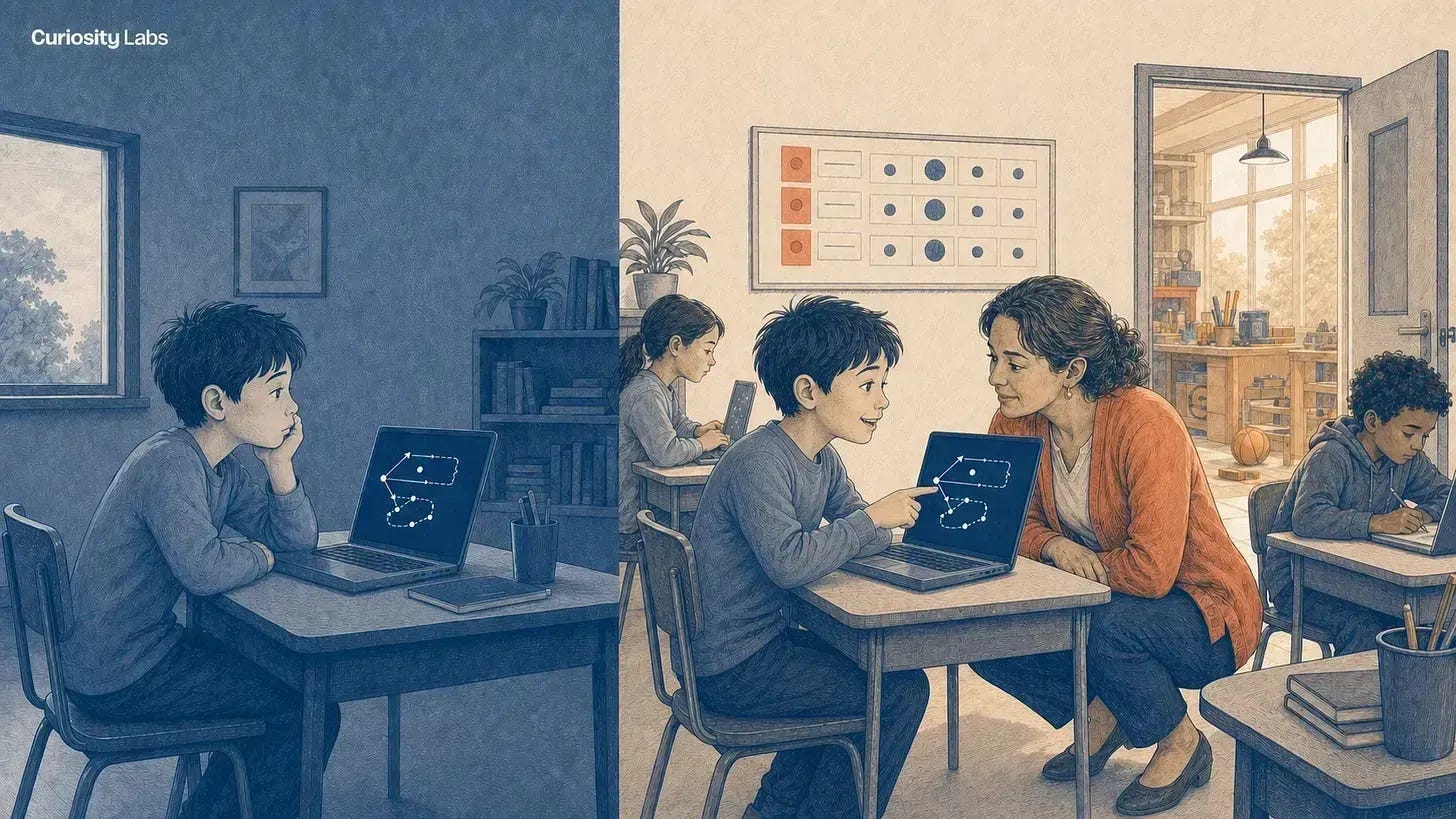
We homeschooled our oldest for first grade last year. By the end of the year, he was working on third-grade math and Chinese. He is back in public school now and happy there, but academically he is mostly coasting through material he already knows. That leaves me wondering how far Alex could go if school kept the things he likes and let him keep learning when he was ready.
Alpha School is trying to build that kind of school. It is a growing network of private schools where children spend the morning working at their own level on learning apps, then spend the afternoon on projects, sports and other activities. Alpha claims its students learn twice as much as they would in a traditional school while spending just two hours a day on core academics.
Many people who work in education roll their eyes at this claim. Their main criticism is selection effects: families willing and able to pay for an unusual private school are likely wealthier and more engaged than average. Alpha also screens children for independence and coachability. It may be selecting children who would have succeeded anyway, then giving the model credit for their results.
The skepticism is understandable. Education has heard versions of this promise before - over the years, we’ve gotten excited about film, TV, computers, and MOOCs - but the basic structure of school has barely changed.
After reviewing the research, my belief is that children can learn much faster than they usually do, and technology can help by giving them work at the right level and pace. But making that work still requires adults and a school environment that keep children motivated and make sure they do the work. Alpha’s software gets most of the attention, but the school it built around it may matter more.
Children really can learn faster, but schools struggle to make it work
In my last article, I looked at why tutoring works. Tutors can adjust the work for each child, skipping what they already know or slowing down when they struggle. A teacher responsible for 25 children cannot adjust as easily.
Schools have tried personalized, mastery-based learning before. The closest and best-studied example is Fred Keller’s system, in which students worked at their own pace, received quick feedback from human proctors, and moved forward only after mastering each unit. Thousands of college instructors used it during the 1970s. A later review of mastery-based learning programs found positive results in high schools and upper-elementary classrooms as well.
A 1979 meta-analysis found that students using Keller’s method finished roughly half a standard deviation ahead of those in conventional courses, equivalent to the difference between the 50th and 69th percentiles. But interest faded over time. It was difficult to run - instructors had to track students moving at different speeds, and procrastination led to lower completion rates. The method worked, but colleges struggled to fit it into their calendars and teaching roles.
What Alpha adds
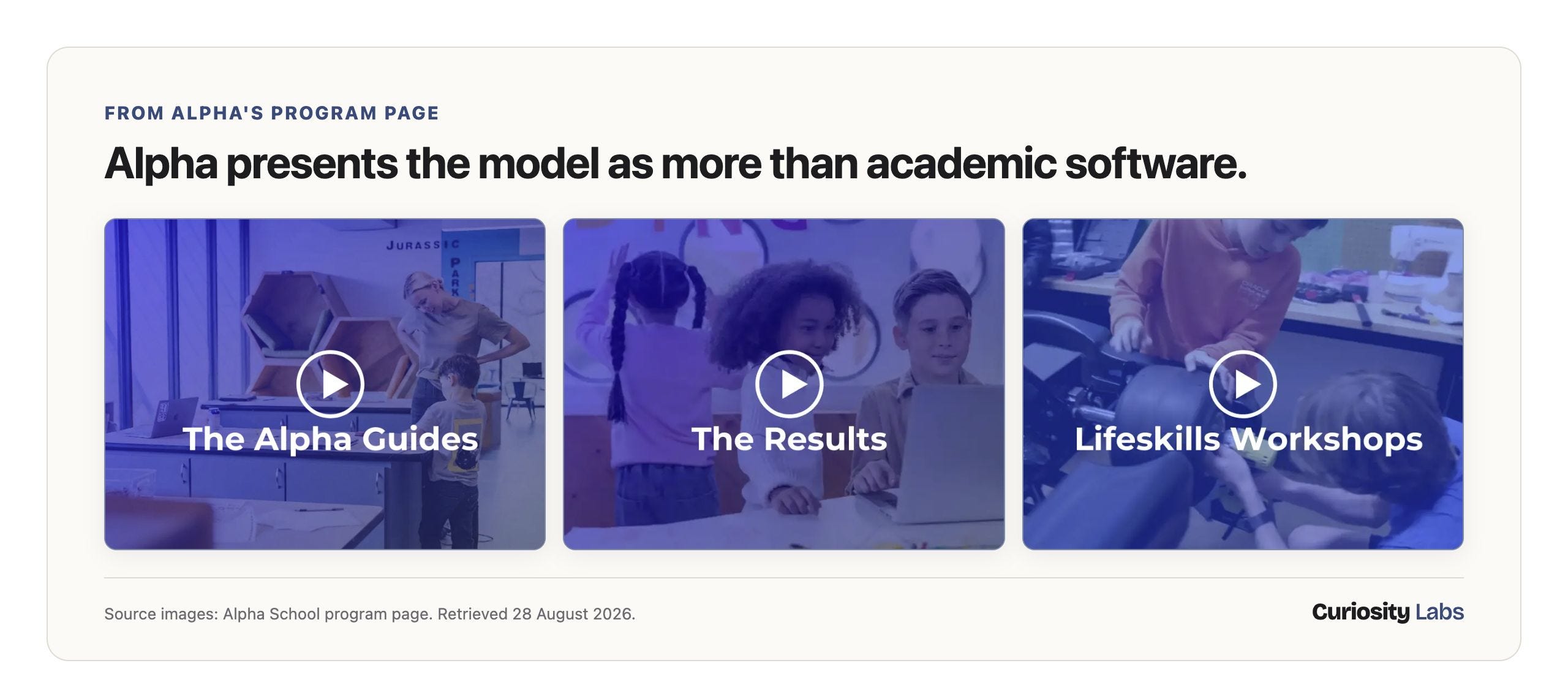
Alpha’s model has three main parts:
Two-hour academics. Students work at their own level using a mix of third-party and Alpha-built apps, while TimeBack assigns work and tracks completion. One detailed parent account describes eight to twelve daily “minimums” and puts the block closer to three hours.
Guides and accountability. Adults monitor effort, set goals and step in when a student starts guessing, slowing down or avoiding the work. Dashboards, deadlines, rewards and messages to parents make it difficult for a child to disappear quietly.
A reason to finish. Completing the minimums releases children to spend the afternoon on projects, sports and friends. Joe Liemandt, one of Alpha’s founders, calls this “time back.”
MAP, a widely used assessment of academic growth, is unusually central to the model. TimeBack uses MAP scores to help place students in each subject, while Alpha uses MAP growth as its main public measure of academic success.
Alpha says students make 2.6x the expected progress on MAP. Liemandt argues that comparing each child with peers at the same starting percentile controls for differences in prior achievement. Its published report shows high achievement and growth, but does not provide enough information to reproduce the 2.6x figure or separate Alpha’s effect from selection.
Liemandt says the Alpha model is roughly 10% technology and 90% motivation. Alpha’s early homeschool program points in the same direction: children used the software for about two hours a day but progressed at roughly the expected rate.
The harder question is what happens when a child repeatedly misses the minimums. Alpha offers remote academic coaches, but former families quoted by WIRED said the help did not always address why their children were stuck. Several described more work or pressure to finish, but little change in the explanation or pace. One family said Alpha warned that their son was so far behind in reading that he might not be invited back and sent home a large package of summer catch-up work.
Alpha strongly disputes WIRED’s reporting and says every current Brownsville family signed a letter rejecting its description. But Alpha markets itself on unusually fast growth. That creates a risk that keeping children on pace takes priority over slowing down when one child needs more help. I asked Alpha when and how it adjusts support or goals after repeated difficulty. It did not answer that question before publication.
So far, Alpha’s strongest results come from in-person private schools. Unbound, a public online school, gives us an early look at the model in a very different setting.
Unbound tried the model under harder conditions
Unbound Academy was created by the team behind Alpha to bring the same basic model to a free, fully online public charter school. Unlike Alpha’s private schools, it accepts all eligible Arizona students in grades 4 through 8. That makes it an early test of how the model works without Alpha’s admissions screening. Citing results from its affiliate schools, Unbound’s charter application set first-year targets of 65% proficiency in English and 60% in math.
Michael Goto, Unbound’s head of school, told me that students spend about 2.5 hours on learning apps each morning, plus another 1.5 hours on Mondays and Fridays. Virtual afternoon clubs include chess, invention and broadcasting. Teachers monitor students online and can pull them into breakout rooms when they get stuck. But if a student never logs in or closes the computer, staff text the family. Repeated incidents lead to an intervention meeting.
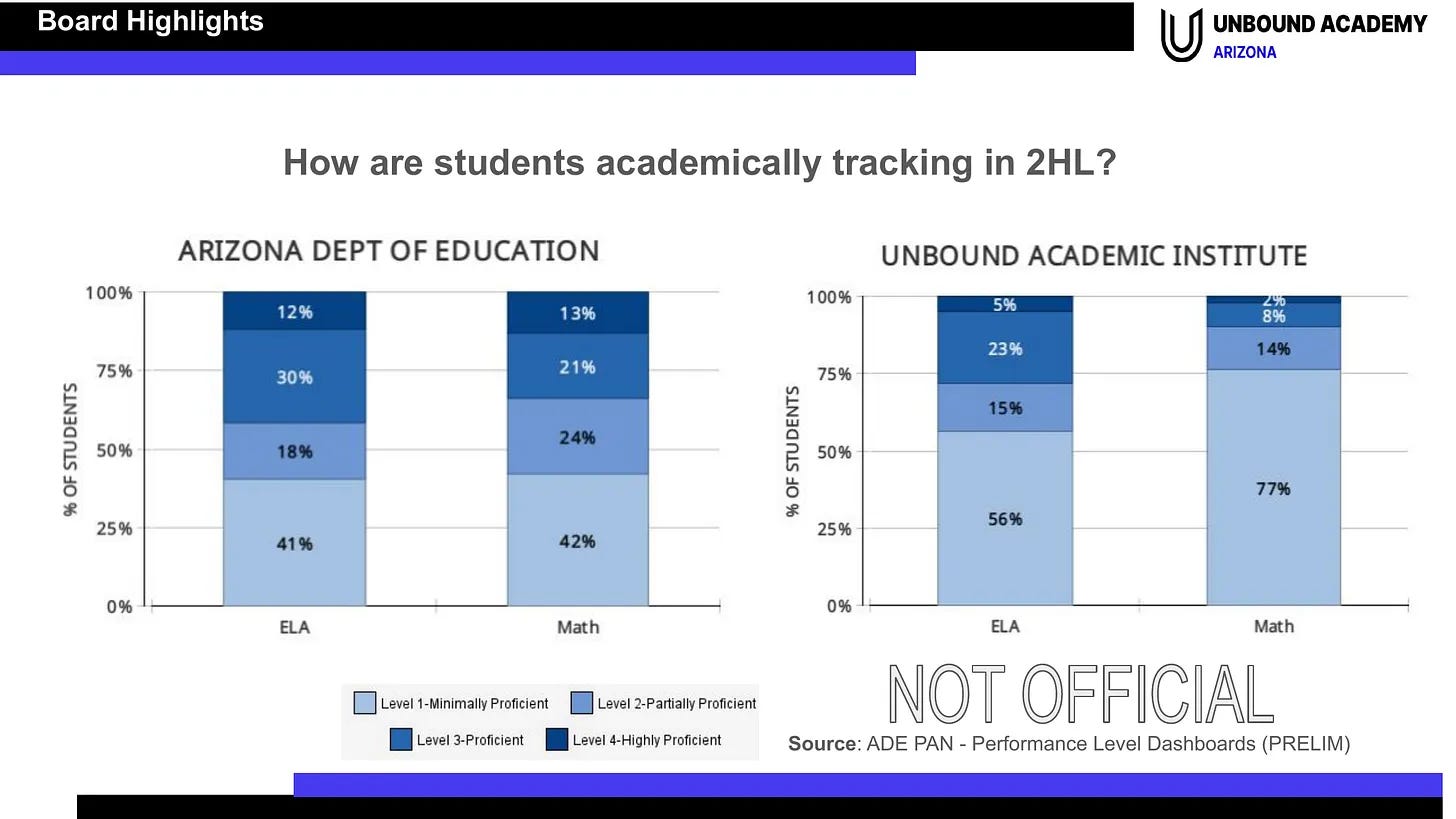
Preliminary board slides show 28% of students proficient in English and 10% in math, below Arizona averages of 42% and 34%. Its MAP figures moved from 2.3x in a January draft to 1.8x in a May update, while its website now says 2.8x. Unbound has not published enough detail to reconcile those figures.
Dan Meyer argues that Unbound’s results show that Alpha’s 2.6x gains come largely from who it admits. I think one year is too early to be that conclusive: Unbound also opened a new school and moved the model online. But its first year suggests that Alpha underestimated how hard the model would be to reproduce.
For its second year, Goto said Unbound lengthened orientation to its goals and rewards, adding academic intervention and making support options clearer to families. He wanted to make sure a student “can’t go through the school day without hearing how it works.”
Unbound may yet become a successful public school. So far, though, it has not provided convincing evidence that Alpha’s reported 2.6x growth carries over to a public online school.
The next tests are already underway
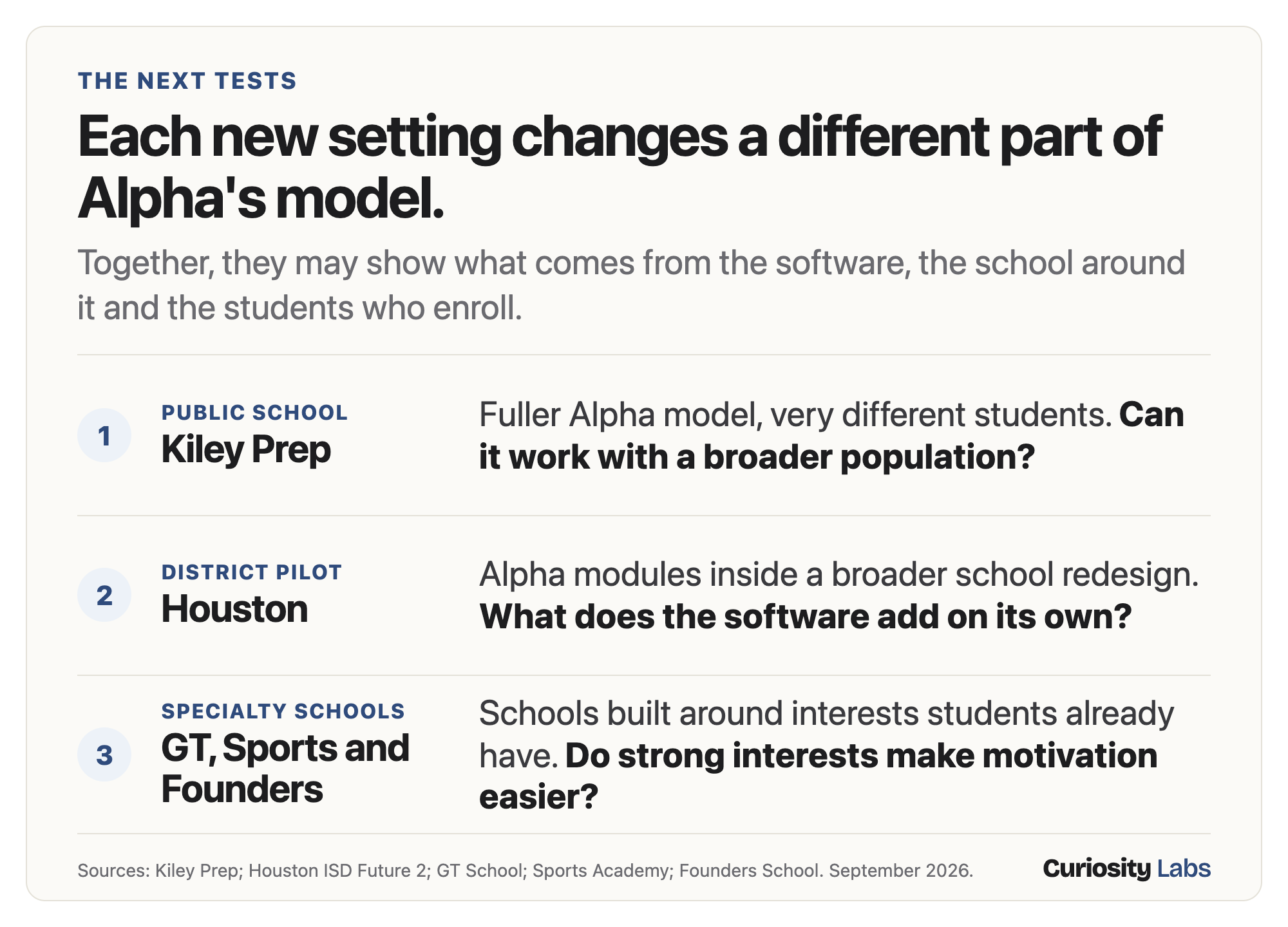
Alpha is now trying the model in both public schools and specialty private schools. The setup is different in each:
Public schools
Kiley Prep. This public middle school in Springfield, Massachusetts, serves a very different population from Alpha’s private schools: 89 percent of students are low income and 39 percent have disabilities. The pilot will start with about 25 sixth graders, who will spend roughly two hours on personalized software with a certified teacher in the room before moving to project-based workshops. Families can opt in or out.
Houston. Selected students who already score relatively well will use Alpha’s learning modules for part of the morning at two of the district’s new Future 2 schools, then rejoin their classmates. The rest of the school day belongs to Houston’s broader redesign, not Alpha.
Specialty private schools
GT School. A K-8 school for gifted students that promises 3x learning and surrounds them with peers who enjoy math competitions, debate, robotics and other hard problems.
Sports Academy. A school for serious athletes that pairs morning academics with afternoon training. Liemandt says it has more than 1,000 voucher-backed students from families earning under $65,000, and predicts they will learn at the same rate as Alpha students.
Founders School. A high school for teenagers who want to build companies. Its first class of 20 freshmen starts in fall 2026, with about three hours of academics followed by the rest of the day building a business.
These programs are still early, but they test different parts of Alpha’s model.
Kiley may show whether a fuller version of Alpha’s model can produce similar gains in a public school with very different students.
Houston is mostly testing the software, and only with students who already score relatively well.
The specialty schools test whether strong interests in academics, sports or entrepreneurship can provide the motivation that Alpha’s model requires.
Together, these tests may tell us how much of Alpha’s results come from the software, the school around it or the students who enroll.
What I think about Alpha
I think Alpha’s model works very well for some children, especially in its flagship schools. Reproducing those results across different students and settings will be much harder.
But Alpha does not need to sustain 2.6x to matter. It is one of the few schools designed around both personalized learning and motivation. Traditional schools struggle with both: one teacher cannot easily keep 25 children at the right level, and finishing early rarely gives a child anything they value.
That does not make Alpha right for every child or family. Its academics rely heavily on apps and targets, and MAP plays a large role in how Alpha defines academic success. That system will work well for some children and families. Others may prefer a less checklist-oriented, lower-pressure way of learning, or simply less screen time.
I am rooting for Alpha to succeed and share what it learns. I also hope it inspires others to build different kinds of schools, because children differ in how they learn and what motivates them. School has needed this kind of experimentation for a long time.
Sources and further reading
David Dockterman. Insights from 200+ Years of Personalized Learning.
Victoria Cain. Schools and Screens.
B.F. Skinner. Teaching Machines.
Kulik, Kulik and Cohen. A Meta-Analysis of Outcome Studies of Keller’s Personalized System of Instruction.
Kulik, Kulik and Bangert-Drowns. Effectiveness of Mastery Learning Programs.
WIRED: Parents Fell in Love With Alpha School’s Promise. Then They Wanted Out.
404 Media: Students Are Being Treated Like Guinea Pigs Inside an AI-Powered Private School.
Sal Khan. Let’s Use Video to Reinvent Education.
Laura Pappano. The Year of the MOOC.
Ho et al. HarvardX and MITx: Two Years of Open Online Courses.
Dan Meyer. Does the Alpha School Model Work for Regular Kids?.
Springfield Empowerment Zone Partnership. Kiley Prep is Preparing to Pilot an Adaptation of the Alpha School Model This Fall.
WBUR. Springfield is piloting an AI-driven classroom. The teachers’ union is trying to stop it.
Houston Chronicle. HISD will use Alpha’s platform at two elementary schools.
Pennsylvania Department of Education. Unbound Academic Institute charter decision.
North Carolina Charter Schools Review Board. September 2024 meeting minutes.
Michael Goto, Unbound Academy head of school, interview with author, September 1, 2026.
Very interesting! I'm curious - would you consider sending your son to Alpha School if it opened in Singapore? Would you be likely to pay for the "One Week Inside Alpha" experience? https://summer.alpha.school/