


I grew up in Singapore and entered the Gifted Education Programme (GEP) at Raffles Institution (RI), a selective secondary school. The first few years were difficult: I was decidedly average. By my final two years before university, I knew how to study and did very well. Singapore gave me an excellent academic education.
I took longer to find interests and direction outside academics. Once schoolwork came easily, I spent many afternoons playing pool and Age of Empires II. My sense of what I could do with my life broadened much later, particularly while working in tech in San Francisco.
Now Katherine and I are raising three boys across Singapore and the US. When we homeschooled Alex, our oldest, he reached third-grade work by the end of first grade, studying for only a couple of hours a day. But teaching him was tiring for us, and he was often bored once his work was done.
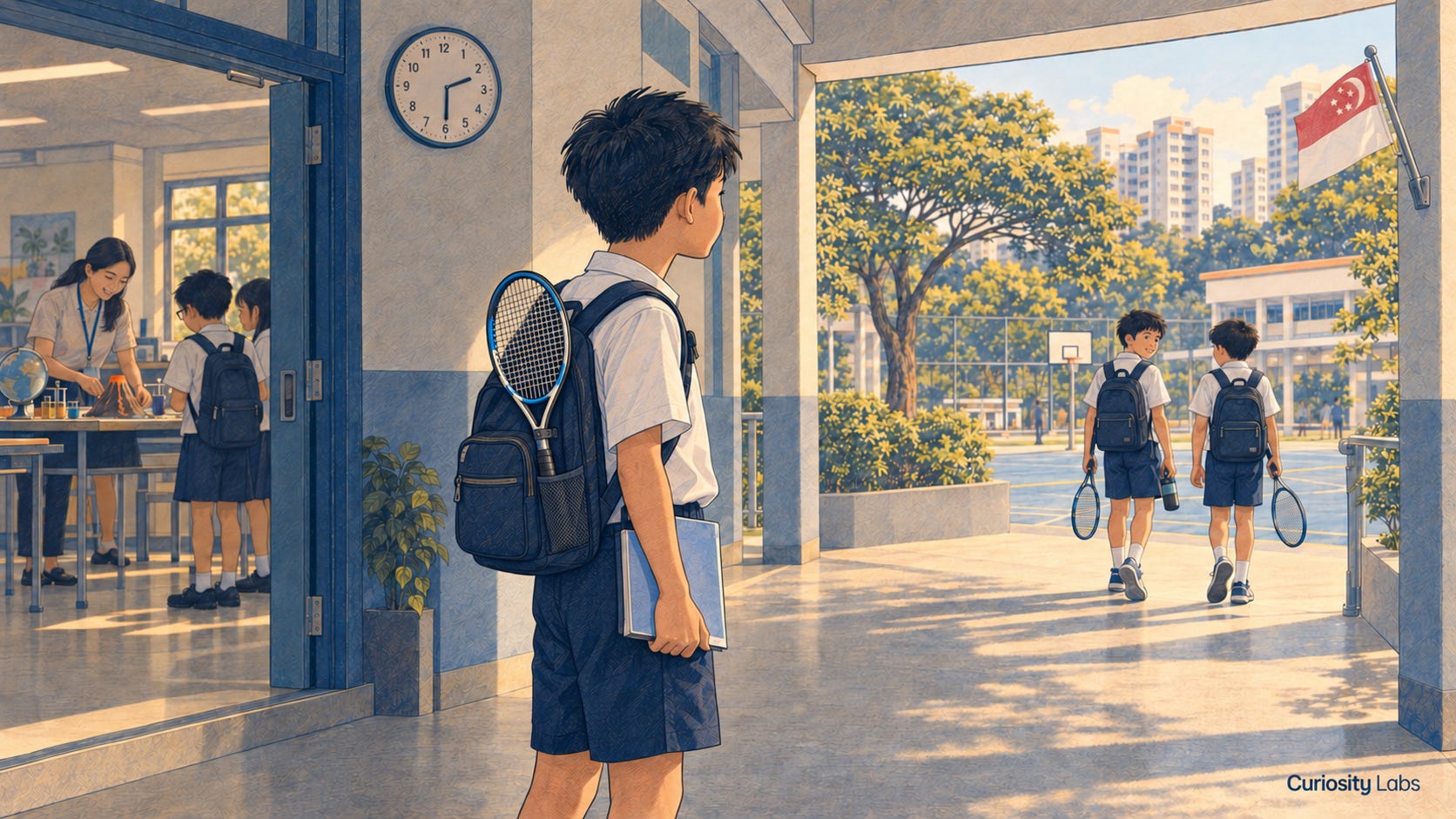
He is now happy in a local primary school, with friends and structure. But he spends much of the school day repeating work he already knows. With tennis five times a week, his schedule is already full, and we’re reluctant to pile on more work after school. He should be stretched academically during the hours he already spends in class, but too much of that time isn’t being used well.
Singapore’s selective secondary schools offer much of the challenge and independence I want for our children. I’m less convinced that primary school makes good use of their time.
Primary school should replace familiar work with harder work
I like Singapore’s gentler start: examinations and weighted assessments have been removed in Primary 1 and 2. Children should have time to play and explore, and eight years old is too early for serious academic pressure.
From P3 or P4, I’d like to see opportunities for brighter kids to stretch more. GEP is meant to give academically advanced pupils more challenge. Beginning in 2027, the program is being revamped in several major ways. I’m not sure I love the changes.
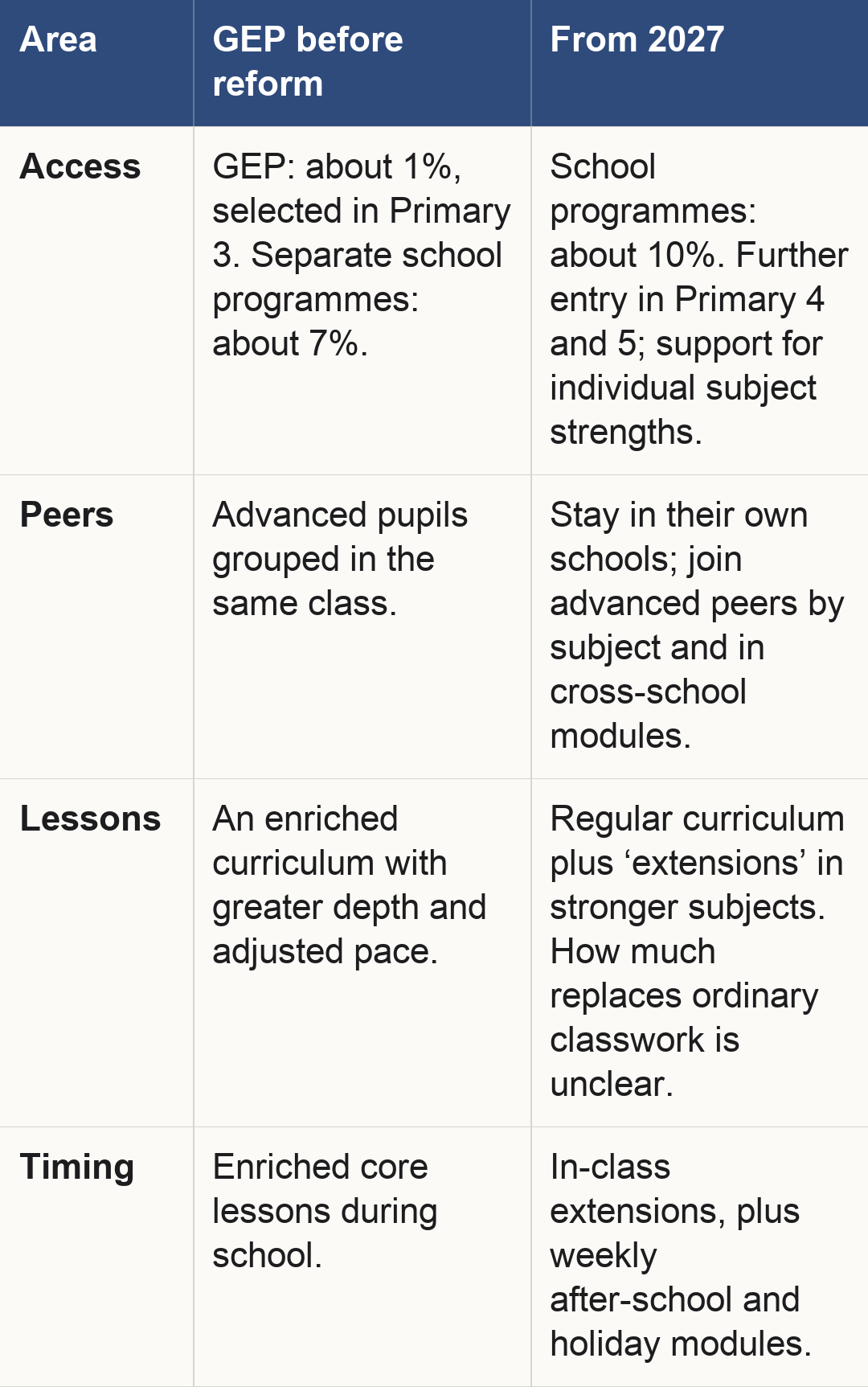
Sources: GEP before the reform; New model from 2027; enriched curriculum.
GEP will now spread support across all primary schools instead of bringing selected pupils into nine GEP schools. I welcome wider access and later entry, but for me, the biggest benefit of streaming and GEP was sharing a classroom with other bright kids, some much brighter than me. They raised the bar of what was possible. I don’t think the new model offers the same experience.
I also expect advanced students to waste class time repeating work they already know. After-school modules offer more challenge and time with bright peers, but take time away from sports, friends and play.
PSLE preparation crowds out real learning
The Primary School Leaving Examination (PSLE) is Singapore’s national exam at the end of the sixth (and final) year of primary school. Its results largely determine which secondary school a child can enter. For many families, much of that year revolves around tutoring, drilling and decisions about which other activities to stop.
A 2026 IPS survey of primary-school parents reports a median of three hours of private tutoring a week. One RI graduate I interviewed stopped piano for PSLE and resumed once academic pressure eased.
The high stakes shape how children spend their time:
Learn ahead. Tutoring or learning at home covers material before school does. Students then spend class time repeating work they already know.
Learn exam technique. Children learn how to score marks without necessarily understanding the subject better.
Keep practising after understanding. Children repeat familiar work to reduce mistakes. Scores can improve even when little new learning happens.
For academically advanced children, PSLE can act as a cap on learning. A child ready for seventh-, eighth- or ninth-grade material is rewarded for returning to sixth-grade work and getting it right more reliably.
PSLE is not the only route into selective secondary schools. Direct School Admission (DSA) lets students earn a place through sports or the arts, rather than PSLE scores alone. But DSA can become another battleground when families choose activities mainly to win a school place, instead of fostering a child’s interest or development.
Selective secondary schools offer more of the education I want
I understand why families make these sacrifices. Schools such as RI, Hwa Chong and NUS High offer advanced pupils many useful opportunities during critical teenage years. The stakes are high.
Students at these selective schools are grouped with peers of similar achievement, guarding against complacency and allowing for greater acceleration. They bypass the national examination most other Singaporeans take around 10th grade, freeing up time for deeper and broader learning.
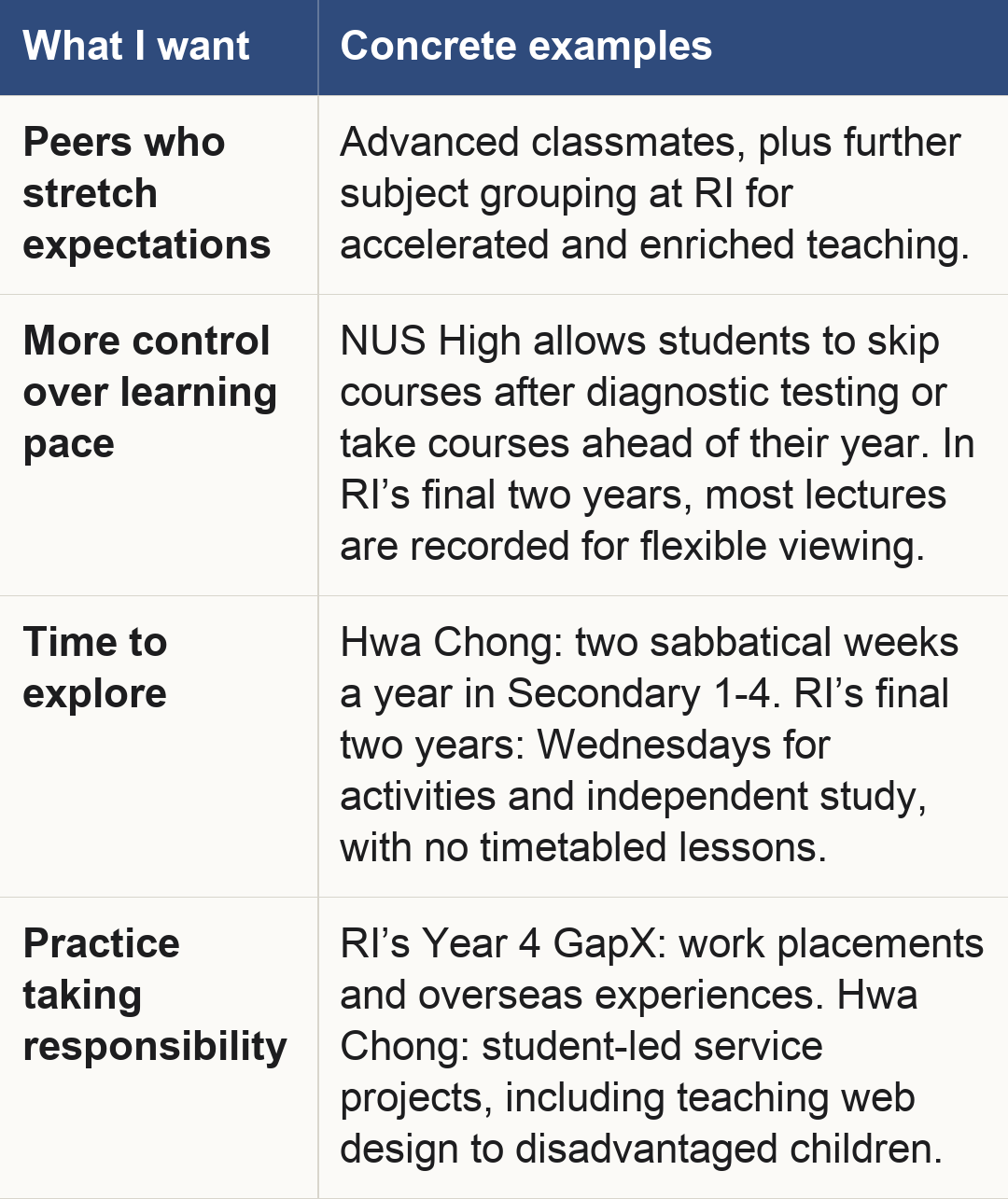
Sources: advanced subject classes; Programme of Studies, pp. 12-13; two sabbatical weeks a year; no timetabled Wednesday lessons; Year 4 GapX programme; Hwa Chong.
I found a wide range of opportunities available at these schools, with real freedom for students to choose what to pursue. One NUS High graduate I interviewed was allowed to work on Olympiad problems during ordinary maths and physics lessons, only joining discussions he found interesting. He also took calculus, linear algebra and physics courses at NUS.
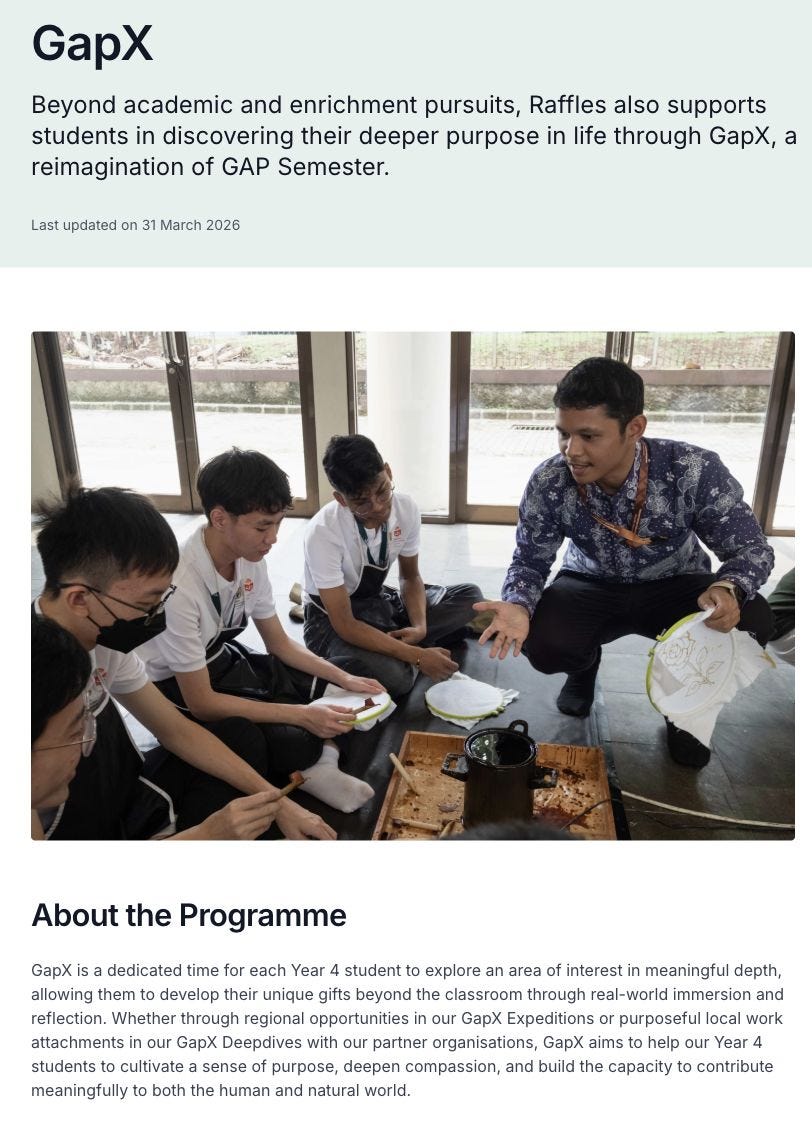
Through RI’s gap-semester programme, another graduate organised a three-week internship with his church’s charity arm, helping run children’s programmes and making home visits. He thought of himself as introverted, but discovered he could teach and continued volunteering through junior college. A short journalism course also helped him rule out a career he had considered.
Students still have to use these opportunities. One RI graduate described classmates who spent much of their extra time gaming. The NUS High graduate also felt he had spent too much time on maths and physics at the expense of relationships. I also heard that parents struggle to keep track of all the opportunities available. Students have to choose and pursue them, which I think is part of the education. This sounds like a major improvement on my own more linear, academically focused RI experience, which included O levels.
Our role as parents
I want our children to benefit from these secondary-school opportunities, but I don’t want their primary-school years to revolve around getting in.
For most of primary school, I would help our children learn beyond grade level where they are ready and pursue interests in depth. Closer to PSLE, I would accept more drilling and exam preparation for a season. They should help decide how much to prepare and what to set aside.
We already practise this with Alex, who is in Primary 2. We support him in tennis, but he can choose another sport or activity to focus on if he wants to stop. We expect him to commit to something, while giving him a say in what that is.
By Primary 6, I think children are ready for bigger choices, with guidance and boundaries. I would expect mine to take PSLE seriously and understand what different schools offer. But if one says, “I don’t want to give up my whole life to study for this exam,” we need to respect that and agree on a reasonable level of preparation. That may mean accepting a different school from the one I would have chosen.
There are many ways to be successful, and secondary school does not decide a child’s future. Wherever our children enrol, they will need to decide what is worth pursuing and how to spend their time. I want them to practise making those choices while we are there to help.